TL;DR
- Launch & Buy creates a Uniswap V2-style liquidity pool and coordinates purchases from multiple buyer wallets.
- The tool plans token approval, initial liquidity, pair creation and buyer transactions in one launch workflow.
- Execution strategy changes by chain. Ethereum and Sepolia use Flashbots, BNB Chain, Polygon and Avalanche prefer fee ordering, and sequencer-based networks such as Base, Optimism, Arbitrum and Robinhood Chain prefer guarded timing.
- Uniswap V2 is supported today because V2 pairs have deterministic addresses, predictable constant-product pricing and straightforward liquidity creation. V3 and V4 support is planned.
- The full launch sequence can be simulated before broadcasting, but simulation does not guarantee future block conditions, relay inclusion or sequencer ordering.
- Serious launches still need technical ownership: custom contracts, RPC strategy, monitoring, failure handling, liquidity planning, security review and post-launch support.
Token launches fail in boring ways before they fail in dramatic ways. The pool is created one transaction too late. Buyer wallets are underfunded. A public transaction lands between the planned buys. The first buy works, the third reverts, and the wallet split no longer matches the launch plan.
That is the problem Launch & Buy is designed to solve. It is a token launch bundle tool for EVM chains that helps create a Uniswap V2-style pool and coordinate buyer wallets according to the execution strategy that makes sense for the selected network.
This guide explains what the tool does, how token bundle buys work, why execution guarantees differ by chain, how buyer targets and FDV estimates are calculated, and when a self-service launch tool is enough versus when a production launch needs custom infrastructure.
What Is a Launch & Buy Bot?
A Launch & Buy bot coordinates the first part of a token market.
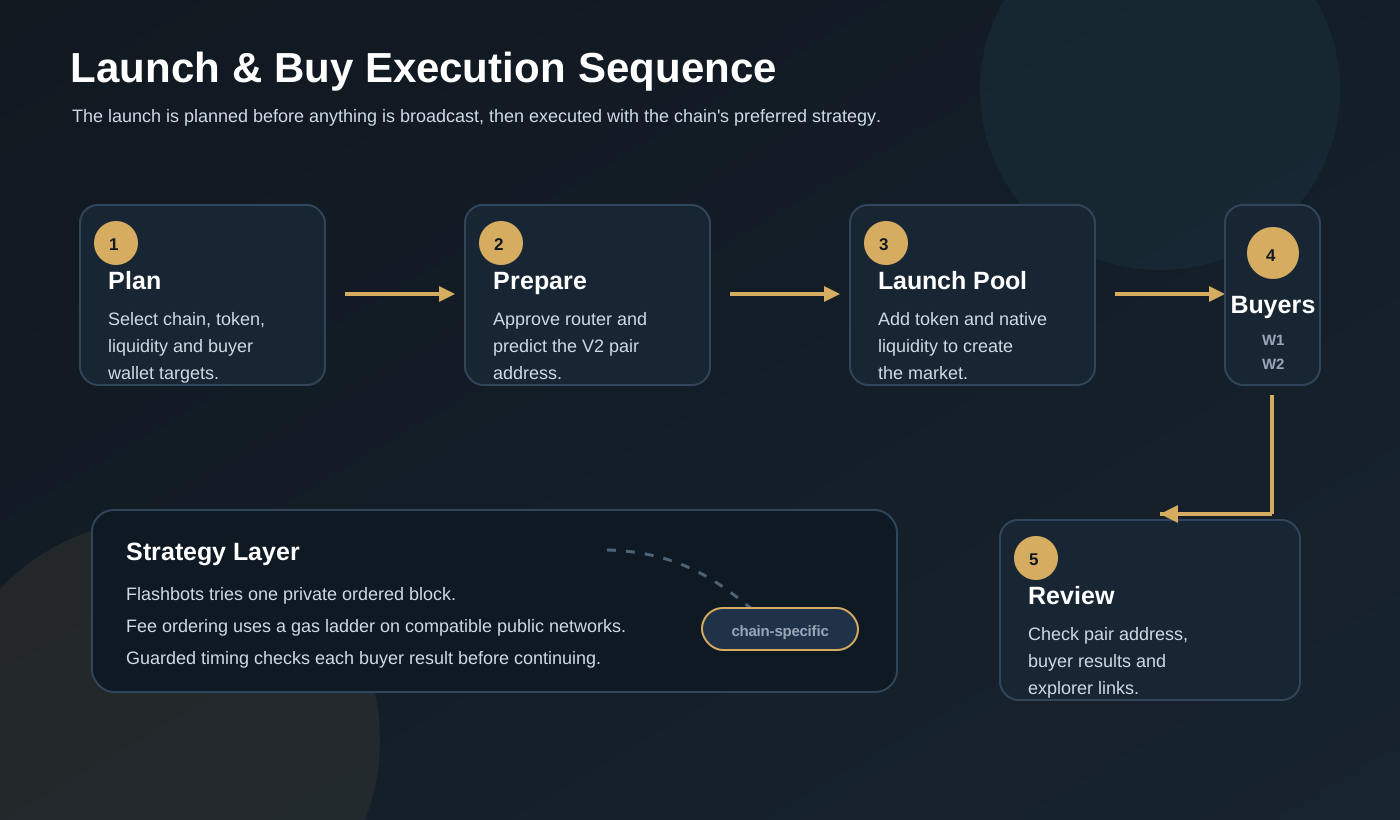
Instead of launching a pool manually, then switching wallets, then trying to buy through the pool one wallet at a time, the tool plans the sequence up front:
- Approve the token for the router.
- Add the initial token and native-currency liquidity.
- Create or initialize the Uniswap V2-style pair.
- Coordinate purchases from multiple buyer wallets.
- Verify the resulting pool, pair address and buyer allocations.
The important part is order. Buyer transactions cannot succeed before the pool exists. If a buyer transaction reaches the chain too early, it reverts. If an outside trade lands between planned buyers, it changes token reserves, native reserves, token output, price impact and wallet allocation.
For a token launch bundle, execution is not just "send a few transactions." It is a sequencing problem.
Launch & Buy handles that sequencing with different strategies depending on the chain. On Ethereum, private bundles can target one atomic block. On some public fee-prioritized networks, a gas-price ladder can target ordered execution. On sequencer-based networks, guarded timing is often safer because higher fees do not reliably control ordering after a sequencer has already received transactions.
That distinction matters. Not every supported chain gives the same atomic guarantee.
Why Token Launch Execution Differs by Chain
There is no universal bundle-buy method across every EVM network.
Ethereum mainnet, BNB Chain, Polygon, Avalanche, Base, Optimism, Arbitrum and Robinhood Chain may all run EVM contracts, but they do not all order transactions the same way. Some networks have public mempools and fee-prioritized inclusion. Some have centralized or permissioned sequencers. Some have private relay support. Some expose transactions in ways that make launch coordination more fragile.
That is why Launch & Buy offers three strategy families.
Flashbots
Flashbots is used for Ethereum mainnet and Sepolia.
The launch and buyer transactions are submitted privately as a bundle. The goal is for the sequence to land in one block, in the exact order provided, or not land at all. That private path also avoids first exposing the launch transactions through the public mempool.
Flashbots is the strongest execution path in the tool, but it is still not magic. Bundle inclusion depends on relay and builder acceptance. A valid simulation improves confidence, but it does not force a builder to include the bundle. A transaction becoming invalid, a nonce conflict, insufficient builder incentive or changed block conditions can still prevent inclusion.
Use Flashbots when the selected chain supports it and the launch needs the strongest same-block private ordering available from the tool.
Fee Ordering
Fee ordering is used on compatible fee-prioritized networks.
The tool assigns each planned transaction a gas price one wei above the following transaction. The intent is simple: launch transaction first, buyer one next, buyer two after that, and so on. This can target ordered, adjacent execution within the same block on networks where validators prioritize by fee.
This is best-effort public execution. It is not the same as a private atomic bundle. The validator or sequencer still controls final placement. RPC latency can affect delivery. Another transaction can still appear nearby. A one-wei ladder signals intended order; it does not guarantee sandwich protection or absolute adjacency.
Use fee ordering when the chain's ordering behavior makes priority-fee sequencing practical and when you understand that the sequence is public.
Guarded Timing
Guarded timing is used where fee ordering is less reliable.
The tool launches the pool, then submits buyer transactions with checks between steps. It verifies whether each buyer reached the planned token target before continuing. If the pool changes outside the plan or a buyer fails to hit the target, the remaining buys stop.
This strategy is slower. It is also more honest for sequencer-based networks where the browser can submit transactions in one order but the sequencer may receive them differently.
On Robinhood Chain, this is especially important. Robinhood's docs describe a first-come, first-served sequencing model where transaction order is determined by arrival time at the sequencer, and users cannot bypass earlier transactions by paying higher fees. That makes a public fee ladder a poor thing to rely on for launch ordering there.
Use guarded timing when safety is more important than speed, or when the network does not give strong fee-ordering guarantees.
Preferred Strategy by Chain
The tool chooses a preferred strategy according to the selected chain.
| Chain | Preferred strategy | Reason |
|---|---|---|
| Ethereum | Flashbots | Private atomic bundle submission |
| Sepolia | Flashbots | End-to-end bundle testing |
| BNB Chain | Fee ordering | Priority-fee ordering can be used |
| Polygon | Fee ordering | Priority-fee ordering can be used |
| Avalanche | Fee ordering | Priority-fee ordering can be used |
| Base | Guarded timing | Sequencer behavior makes timing safer |
| Optimism | Guarded timing | Sequencer behavior makes timing safer |
| Arbitrum | Guarded timing | Fee ladders do not reliably control ordering |
| Robinhood Chain | Guarded timing | First-come, first-served sequencing |
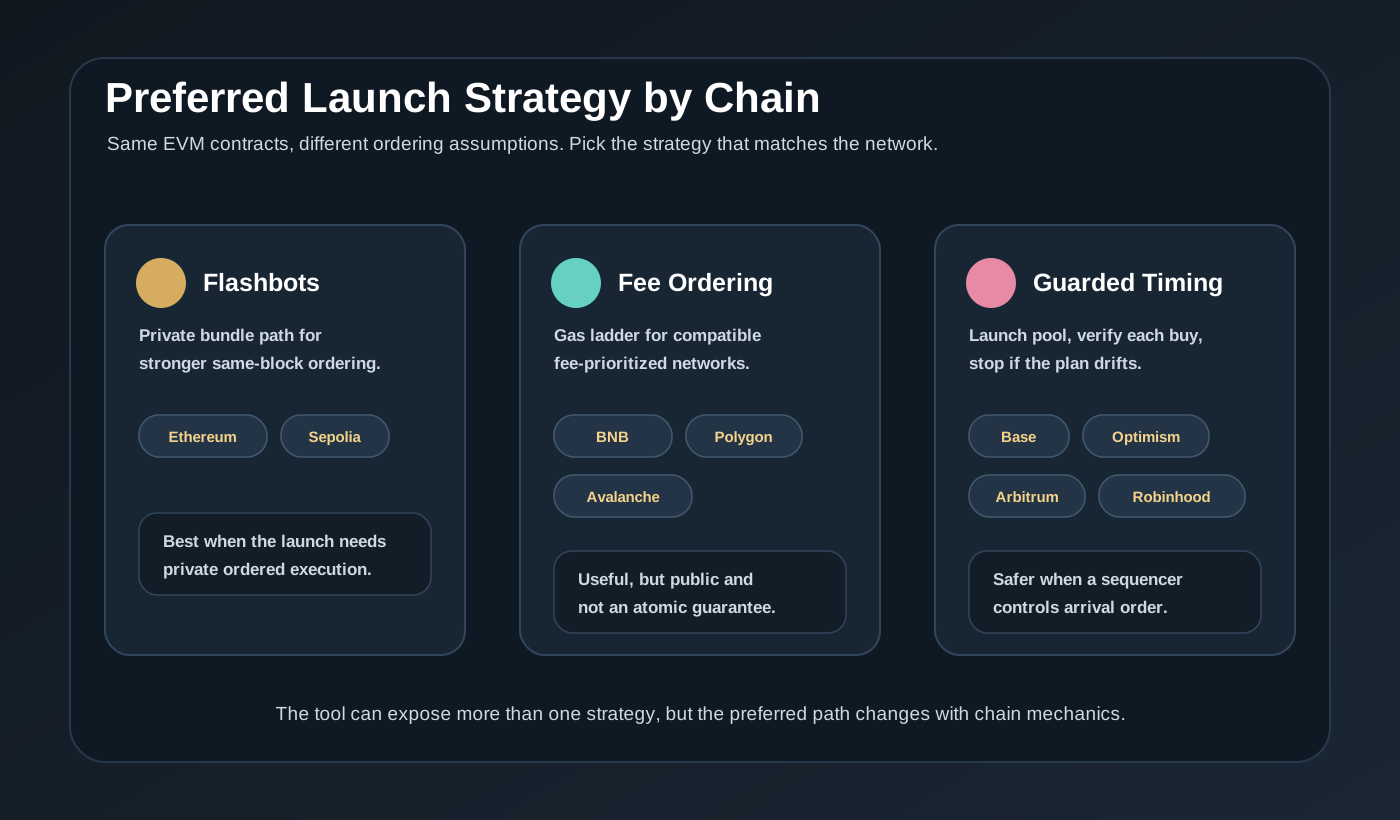
Some strategies may remain selectable when technically supported, even if they are not the recommended path. That is intentional. Launch execution is situational. A team testing on Sepolia may want Flashbots. A simple public launch may accept fee ordering. A Robinhood Chain memecoin launch may prefer guarded timing because the network's first-come sequencer makes fee-based ordering assumptions weaker.
The point is not to pretend every chain behaves like Ethereum. The point is to choose the right launch strategy for the chain you are actually using.
Why Uniswap V2 Is Supported First
Launch & Buy supports Uniswap V2-style pools today.
That is not because V2 is new or glamorous. It is because V2 is predictable.
V2-style pools provide:
- Deterministic pair addresses.
- Straightforward liquidity creation.
- Predictable constant-product pricing.
- Broad EVM deployment compatibility.
- Easier transaction planning across multiple wallets.
Uniswap's own V2 docs describe how pair addresses can be computed with CREATE2 before doing an onchain lookup. That matters for Launch & Buy because the tool can preview the pair address before the pool exists.
V2 also has a simpler pricing model than concentrated liquidity. Every buy adds native currency to the pool and removes tokens from the pool. The ratio moves, the price changes, and later buyers generally pay more for the same token output.
That simplicity makes V2 the right first target for a launch coordination tool.
Uniswap V2 is supported today. V3 and V4 support is planned.
The strategy behind the article and the tool is broad enough that more pool versions can be introduced later without changing the core lesson: launch execution is about liquidity, ordering, buyer allocation and risk control.
How the Launch & Buy Tool Works
The self-service flow is built to make the launch plan visible before anything is broadcast.
Here is the practical sequence:
- Select a supported chain.
- Select an existing token.
- Follow the link to create a token if one does not exist yet.
- Choose how many tokens to place into liquidity.
- Choose the amount of native currency to add as liquidity.
- Add one buyer private key per line.
- Set the combined buyer supply target.
- Review expected tokens and required wallet balances.
- Review the estimated token price and fully diluted valuation.
- Select the execution strategy.
- Simulate the complete launch.
- Execute the pool launch and buyer sequence.
- Review the pair address, transaction links and Dexscreener link.
The tool calculates the pair address deterministically before the pool is created. That helps you inspect the plan, share expected routes internally, and understand exactly which token/native pair the launch will create.
It also checks buyer funding requirements. That is not a nice-to-have. If a buyer wallet is underfunded, the planned sequence can fail or drift away from the intended distribution.
Chain-Specific Launch Pages
You can start from the main Launch & Buy tool, or go directly to a chain-specific path:
- Ethereum Launch & Buy
- BNB Chain Launch & Buy
- Base Launch & Buy
- Polygon Launch & Buy
- Avalanche Launch & Buy
- Arbitrum Launch & Buy
- Optimism Launch & Buy
- Robinhood Chain Launch & Buy
- Sepolia Launch & Buy
For Robinhood Chain launches, read the Robinhood Chain builder guide first. The chain is EVM-compatible, but the sequencing model changes launch assumptions.
How Buyer Supply Targets Work
The buyer target is set as a combined percentage of the token's total supply.
The tool divides that target equally between the valid buyer wallets.
Example:
- Total supply: 1 billion tokens.
- Buyer target: 9%.
- Buyer wallets: 9.
- Target per wallet: approximately 1% of total supply.
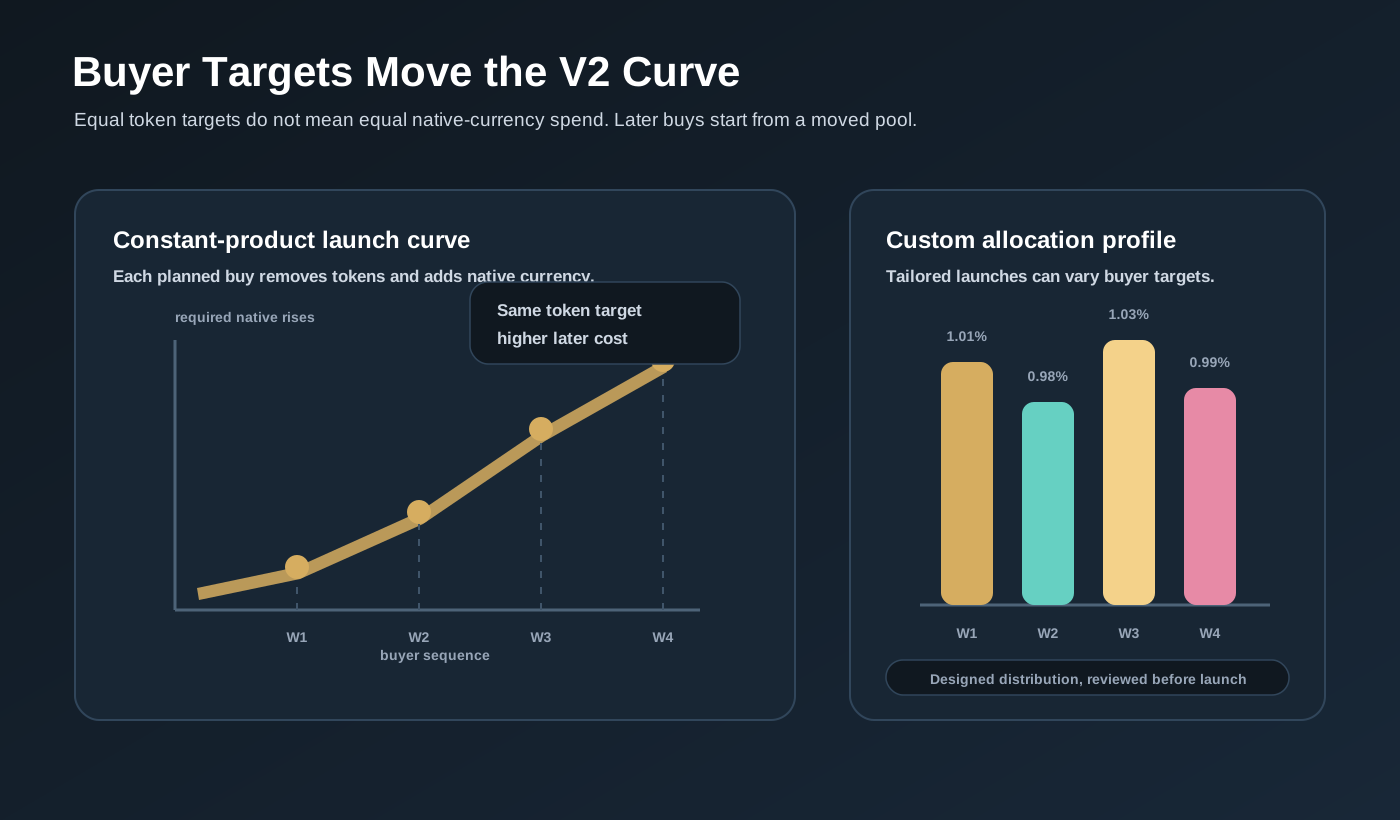
That sounds simple, but the cost is not equal across wallets. The first buyer buys against the initial pool. The second buyer buys after the first buyer has already moved the pool price. The ninth buyer buys after eight previous buys have removed tokens and added native currency.
Later buyers generally need more native currency for the same token amount.
The maximum target also depends on how many tokens you put into liquidity. Buyers cannot purchase more tokens than the pool makes available. If you put too few tokens into the pool and set an aggressive buyer target, the math will fail before the launch is executable.
Actual results remain subject to:
- Uniswap V2 pool mathematics.
- Rounding.
- Router behavior.
- Gas.
- Slippage.
- Competing trades.
- Network ordering.
- RPC reliability.
Launch & Buy gives you the plan. The chain still decides the final execution.
Custom Buyer Allocation Profiles
The self-service tool splits the combined buyer target evenly across valid buyer wallets. That is the simplest default and the easiest model to review.
Tailored launches can use a more deliberate holder profile. Instead of giving every buyer wallet exactly 1.00% of supply, a custom launch might use small variations such as 1.01%, 0.98%, 1.03% and 0.99%, depending on the launch plan, wallet count, liquidity depth and target distribution.
That kind of allocation profile is custom work because it changes the math for every wallet. Each buyer has a different token target, a different native-currency requirement and a different effect on the pool curve.
Use this for realistic distribution planning, treasury structure, staged community allocations or launch operations. Do not use it to mislead buyers about who controls supply. If the project has meaningful capital or reputation behind it, the holder plan should be designed intentionally, documented internally and reviewed before launch.
Understanding Price Impact and FDV
Uniswap V2 uses constant-product pricing.
In plain English: the pool starts with two reserves. One reserve is your token. The other is the chain's native wrapped asset, such as WETH, WBNB, WAVAX or the chain's equivalent. The product of those reserves determines the curve. When a buyer adds native currency to buy tokens, the native reserve increases and the token reserve decreases.
The immediate result is price impact. The first buy moves price. The second buy starts from the new price. The third buy starts from the price after the second buy.
That is why a bundle-buy plan needs math before execution. If each buyer wallet is meant to receive roughly the same token amount, the required native-currency spend generally rises through the sequence.
There are four different numbers founders often mix together:
| Metric | Meaning |
|---|---|
| Liquidity | The assets deposited into the pool |
| Token price | The current pool ratio after launch or buys |
| Circulating market cap | Circulating supply multiplied by price |
| Fully diluted valuation | Total token supply multiplied by price |
Launch & Buy estimates fully diluted valuation after the initial pool and after each planned buy. That is useful for launch planning, but FDV is not the same thing as circulating market cap unless the full supply is circulating.
Do not use FDV as a fake headline number. Use it as a planning number.
Simulating a Token Launch
Simulation checks the proposed sequence against current chain state without broadcasting transactions.
It can catch problems such as:
- Insufficient launch-wallet balance.
- Insufficient buyer-wallet balances.
- Missing token approvals.
- Invalid liquidity amounts.
- Buyer targets that exceed available pool tokens.
- Minimum-output failures.
- Contract reverts.
- Unsupported RPC simulation methods.
- Pending nonce issues.
Simulation is one of the most useful parts of the tool because it forces the launch plan to meet reality before real funds move.
It still has limits. A simulation is a snapshot. It cannot guarantee future block conditions, Flashbots relay inclusion, validator placement, sequencer arrival order, RPC latency, or whether another transaction will touch the pool first.
The right mental model is:
Simulation tells you whether the plan works now. It does not promise the world will stay still later.
That is why serious launches usually combine simulation with controlled wallet funding, private execution where possible, monitoring, clear abort conditions and post-launch support.
What Happens After Execution?
After execution, the result screen gives you the information needed to inspect the launch:
- Final pair address.
- Liquidity transaction details.
- Buyer transaction details.
- Block explorer links.
- Dexscreener link where the network is indexed.
- Buyer results and final token allocations.
For testnets, Dexscreener may not show the pair. Use the relevant block explorer instead.
For mainnet launches, do not stop at "the transaction succeeded." Check the pool, buyer balances, remaining launch-wallet balances, token approvals, ownership status, liquidity position and public chart.
The launch is the start of operations, not the end.
Security and Private Keys
Launch & Buy requires buyer wallets to sign buyer transactions. Treat that seriously.
Use newly created, dedicated wallets for buyer transactions. Do not paste private keys belonging to treasury wallets, personal wallets, long-term storage wallets, hardware-wallet-controlled reserves or anything you cannot afford to retire after the launch.
Practical safety rules:
- Use fresh buyer wallets.
- Fund each wallet only with the amount required for the launch and gas.
- Keep launch and treasury wallets separate.
- Confirm the selected chain.
- Confirm the token address.
- Confirm the router and pair details.
- Confirm liquidity amounts.
- Run simulation before executing.
- Check every generated address and transaction.
- Revoke approvals that are no longer needed.
- Sweep unused balances after launch with a dedicated operations flow.
The tool signs launch and buyer transactions locally in the browser. That is better than sending private keys to a server, but it is not a reason to be casual. Your browser, extensions, clipboard, machine and wallet hygiene still matter.
Use the tool from a clean environment. Do not paste valuable long-term keys into any web tool, including ours.
Limitations and Execution Guarantees
This section matters more than the marketing copy.
Launch & Buy is a coordination tool. It improves launch execution, but it does not suspend network reality.
The main limitations:
- Flashbots bundles depend on relay and builder acceptance.
- Public fee ordering cannot force validator behavior.
- A one-wei fee ladder targets adjacent ordering but is not guaranteed sandwich protection.
- Timed buying is guarded, but it is not one atomic transaction across every buyer.
- RPC latency and reliability can affect public transaction delivery.
- Sequencers may receive transactions in a different order from the order in which the browser sent them.
- Price movement and competing trades can change buyer outputs.
- Simulation reflects current chain state, not guaranteed future state.
- Uniswap V2 is supported today. V3 and V4 support is planned.
That is the honest version. Anyone promising perfect atomic execution across every EVM chain is either simplifying too hard or selling you something fragile.
Launch & Buy for Memecoins and Airdrops
Memecoin launches are one of the places this tool is immediately useful, especially on newer EVM chains like Robinhood Chain where early activity can move quickly.
That does not mean every memecoin is worth building. Most are short-lived. Many have no plan beyond the first chart candle. We are not interested in pretending otherwise.
But serious memecoin launches still need good execution:
- Clean token deployment.
- Sensible initial liquidity.
- Buyer wallet planning.
- Airdrop mechanics.
- Wallet balance checks.
- Operational wallets.
- Permission cleanup.
- Launch monitoring.
- Post-launch support.
The same applies to airdrops. A distribution is not just "send tokens to a list." You need to clean the recipient list, test a small send, verify balances, avoid duplicate rows, fund wallets, and keep records of what happened.
Launch & Buy pairs naturally with:
- Token Creator for deployment.
- Multisender for airdrops and community distributions.
- Bulk Balance Checker for pre-launch and post-launch wallet checks.
- Asset Sweeper for consolidating operational wallets.
- Revoke Permissions for cleanup after testing.
The tools let you play with the chain and understand how the launch flow behaves. If the project has real capital, a serious community or reputation on the line, use the tools to learn, then bring in a partner for the production system.
Self-Service Tool vs Production Launch Infrastructure
The self-service tool is useful for testing and straightforward launches.
It is not a replacement for custom launch infrastructure when the stakes are higher.
More serious launches may require:
- Custom smart contracts.
- Custom buyer allocation profiles.
- Private relay relationships.
- Dedicated RPC infrastructure.
- Treasury controls.
- Launch monitoring.
- Automated failure recovery.
- Security review.
- Liquidity planning.
- Market-making coordination.
- Airdrop or claim systems.
- Post-launch operational support.
This is where All Things Web3 can help beyond the tool.
We can own the contracts, frontend, backend, deployment scripts, launch plan, airdrop mechanics, buyer-wallet flow, RPC setup, monitoring and support. That includes serious memecoin launches, utility-token launches, Robinhood Chain experiments, Base launches, BNB Chain launches, and custom EVM deployments.
We are not a conventional development agency or a source of unpaid launch labor. We work as a founder-led technical partner. Custom engagements require a paid commitment or deposit. For selected projects, equity or revenue share can be part of the commercial arrangement, but never instead of payment.
If you need that level of ownership, apply to build together.
Common Mistakes That Break Launches
Mistake 1: Assuming Every Chain Supports Atomic Bundles
Ethereum with Flashbots is not the same as every other EVM chain.
Some chains support private bundle-style execution. Some can be influenced with fee ordering. Some are sequencer-driven and need guarded timing. If you use the wrong mental model, the launch plan breaks.
Choose the strategy for the chain, not the story you wish the chain had.
Mistake 2: Underfunding Buyer Wallets
Later buyers usually need more native currency than earlier buyers because previous buys move the pool price.
If every wallet receives the same funding amount, later wallets may fail. Use the tool's required balance estimates and leave room for gas movement.
Mistake 3: Confusing FDV With Market Cap
FDV is total supply multiplied by token price. Market cap depends on circulating supply.
If only a small part of supply is liquid or circulating, calling FDV "market cap" gives everyone the wrong picture.
Mistake 4: Using Valuable Private Keys
Buyer wallets should be dedicated operational wallets. They should not be personal wallets, treasury wallets or wallets that hold long-term assets.
After a launch, assume those buyer wallets are operationally exposed and move anything unnecessary out.
Mistake 5: Skipping Simulation
Skipping simulation saves a few minutes and can cost the launch.
Run the simulation. Fix the obvious failures before funds move.
Mistake 6: Treating Launch Day as the Whole Plan
A token launch includes what happens after the pool goes live: liquidity checks, ownership decisions, token approvals, chart links, community communication, airdrops, wallet operations and support.
The first block matters. The next 24 hours matter more.
Frequently Asked Questions
What is a token bundle buy?
A token bundle buy coordinates pool creation and purchases from multiple wallets according to a planned transaction sequence. The goal is to launch the pool and execute buyer wallets in a controlled order.
Is Launch & Buy an atomic bundle bot?
Launch & Buy uses private bundles, fee ordering or guarded timing depending on the chain. Flashbots can provide atomic Ethereum execution subject to relay and builder acceptance. Public and timed strategies have different guarantees.
Which chains support Flashbots?
Launch & Buy uses Flashbots for Ethereum mainnet and Sepolia.
Can I test the launch before broadcasting?
Yes. The tool includes simulation to check the planned pool launch and buyer sequence against current chain state before broadcasting.
Does the tool support Uniswap V3 or V4?
Not yet. Uniswap V2 is supported today. V3 and V4 support is planned.
Can another transaction land between the buyer wallets?
That depends on the strategy. Flashbots provides the strongest private ordering. Fee ordering and guarded timing cannot guarantee that no outside transaction will intervene.
Does the tool guarantee protection from sandwich attacks?
No. Private bundles offer stronger protection because transactions are not first exposed in the public mempool. Public strategies remain exposed to network, validator, sequencer and ordering behavior.
How is buyer allocation calculated?
The combined supply target is divided equally between the valid buyer wallets. The native-currency required for each wallet is then calculated against the changing Uniswap V2 reserves.
Where can I see the pool after launch?
The result screen provides the pair address, block explorer links and a Dexscreener link where the network is indexed. Testnet pairs may need to be inspected directly through the block explorer.
Can All Things Web3 build a custom launch system?
Yes. We can build custom contracts, launch tooling, airdrop systems, dashboards, monitoring, wallet operations and post-launch support. Serious work requires a paid commitment or deposit.
The Bottom Line
Launch & Buy exists because the first moments of a token market are not forgiving. Pool creation, liquidity, wallet buys, gas, routing and ordering all need to line up.
For straightforward launches, use the Launch & Buy tool, simulate the sequence, confirm wallet funding and execute with the chain's recommended strategy.
For serious launches, use the tool to understand the mechanics, then build the production launch infrastructure properly.
Here's what you need to remember:
There is no universal atomic bundle guarantee across every EVM chain. Ethereum Flashbots, public fee ordering and sequencer-based guarded timing are different tools for different environments.
The decision is simple:
If you are testing or running a straightforward launch, start with Launch & Buy. If the launch involves meaningful capital, a real community, custom tokenomics, airdrops, market-making, private execution needs or reputational risk, bring in a technical partner.
What we recommend:
Simulate first. Use dedicated buyer wallets. Fund them correctly. Choose the strategy that matches the chain. Treat FDV as FDV, not circulating market cap. Clean up approvals and operations after execution. If you want All Things Web3 to own the launch system end to end, apply to build together.
Related Resources
All Things Web3 tools:
- Launch & Buy
- Ethereum Launch & Buy
- BNB Chain Launch & Buy
- Base Launch & Buy
- Robinhood Chain Launch & Buy
- Token Creator
- Multisender
- Bulk Balance Checker
- Asset Sweeper
External references: